
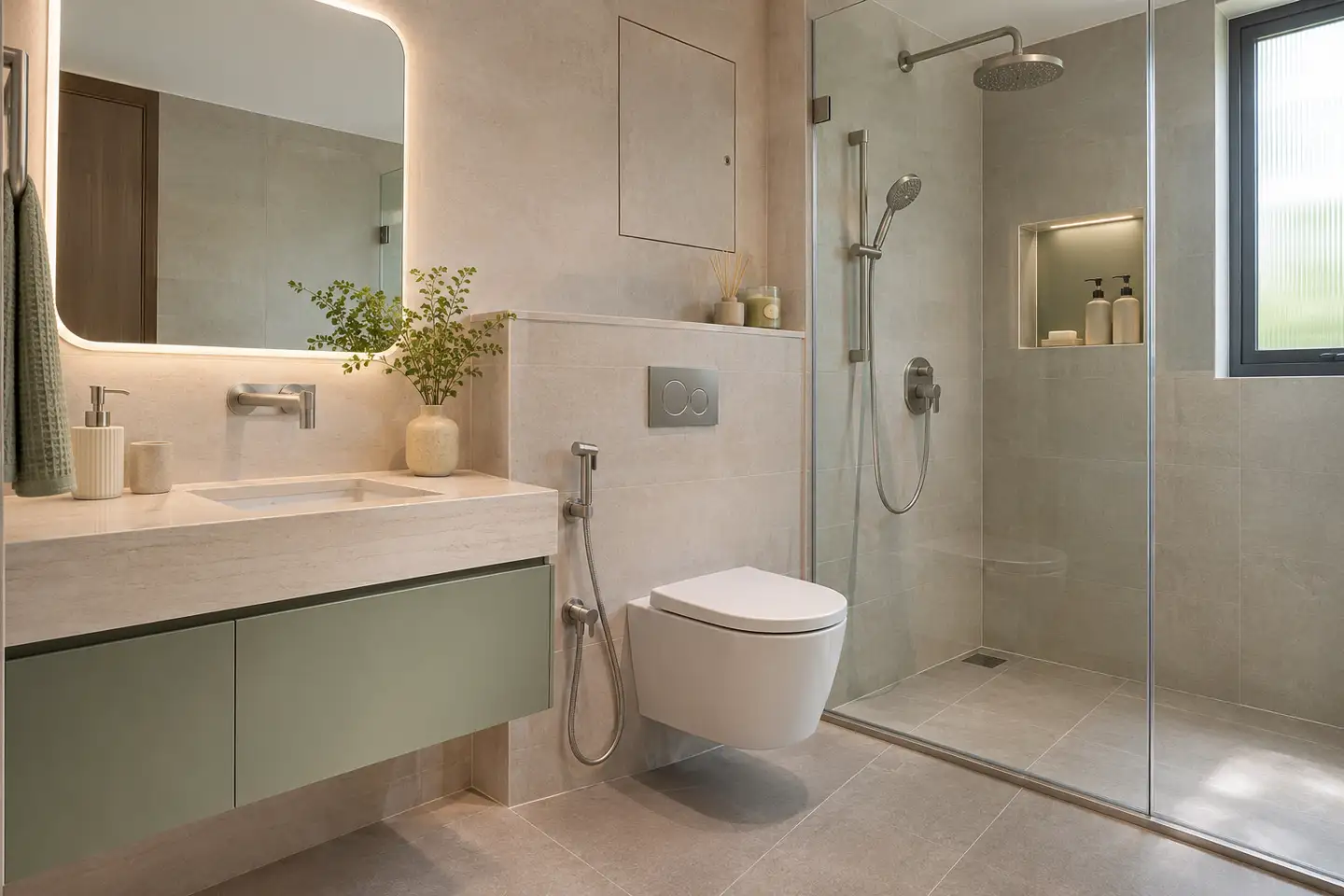
Featured image: illustrative design concept.
A bathroom can feel luxurious without delivering an unnecessarily large volume of water every time a tap is opened. The quality of the experience depends just as much on the temperature, spray pattern, layout and ease of use as it does on the fittings themselves. In Indian apartments, where supply conditions and water quality can vary considerably, these details deserve attention before the tiles are selected.
Recent coverage in Hindustan Times and Business Standard reflects growing interest in bathrooms as carefully designed personal spaces. Financial Express has also reported on the expanding range of premium shower experiences. The opportunity for homeowners is to bring the same attention to resource efficiency as to appearance. The Bureau of Energy Efficiency's Eco-Niwas Samhita 2024 provides a broader residential sustainability framework, including water conservation.
Begin with the household, not the showroom
Observe how the bathroom is actually used. One family member may prefer a bucket bath, another a hand shower, while children may need help with bathing. A guest bathroom might be used infrequently but must remain easy to operate. These routines should inform product selection rather than being forced to change around a fashionable fixture.
Ask the building maintenance team about available water pressure, supply interruptions, water treatment and whether the flushing supply is separate. In an existing apartment, establish what can be altered without disturbing common services. A fitting that performs beautifully in a showroom may behave very differently in your home. Request technical specifications and check compatibility with the actual supply conditions.
Make every fitting earn its place
At the basin, choose a tap that produces a comfortable stream without unnecessary splashing. Consider a compatible aerator or a flow-regulating fitting, and specify a basin shape and spout reach that work together. A shallow basin with an excessively tall spout can send water onto the counter, creating additional cleaning work.
For the shower, compare declared flow rates at comparable pressures rather than relying on descriptions such as eco or luxury. Try the spray if a working display is available. A satisfying hand shower can be more practical than a large overhead assembly, particularly when washing children or cleaning the enclosure. Multiple outlets need not operate simultaneously to offer variety.
A dual-flush toilet offers a choice of flush volumes. Look for documented performance and a reliable service network. The ability to obtain replacement seals and valves is more valuable over the life of the bathroom than an unusual flush-button finish.
Understand the numbers without chasing promises
Water consumption is a function of both flow and duration. As a simple calculation, a shower delivering eight litres per minute uses forty litres in five minutes. A shower delivering twelve litres per minute uses sixty litres over the same period. These are illustrative assumptions, not measured results or guaranteed savings. Actual consumption depends on pressure, product performance and bathing habits.
A useful comparison sheet should include the model number, declared flow or flush volume, test conditions, warranty and availability of spare parts. Make this part of the approval process. It is much easier to compare products before purchasing than to discover an unsuitable fitting after installation.
Reduce the wait for hot water
Standing beside a shower while cold water runs down the drain is a familiar frustration. The distance between the heater and outlet, the pipe layout and the heating system all influence the experience. Coordinate the location of the water heater and hot-water outlets with a qualified plumbing professional before closing walls or ceilings.
Where appropriate, consider insulated hot-water pipes and efficient routing. Larger homes with central hot-water systems may need a specialist assessment of circulation options and their energy implications. Avoid specifying extra equipment simply because it sounds efficient; the solution should suit the household's actual demand.
Design wet and dry areas to work together
A well-positioned shower screen helps contain splashes, keeping the vanity and circulation area easier to maintain. Plan drainage, floor falls and waterproofing as a coordinated system. Select flooring with suitable wet-area slip resistance rather than judging it only by appearance. A visually seamless floor still needs to drain correctly.
Keep towels, toiletries and everyday cleaning supplies close to where they are needed without exposing everything to shower spray. A floating vanity can make cleaning underneath easier, provided the wall and fixings are suitable. Generous mirror lighting and a calm material palette can create the sense of refinement often associated with much larger bathrooms.
Make maintenance visible in the drawings
Concealed plumbing contributes to a clean aesthetic, but concealed should never mean inaccessible. Agree on access to isolation valves, cistern mechanisms, traps and serviceable components. Ask how a faulty fitting can be repaired without breaking finished surfaces. Document these details before construction begins.
Hard water can leave mineral deposits on aerators and shower nozzles. Choose finishes and fittings that can be cleaned according to manufacturer instructions, and make removable components easy to reach. Persistent dripping or a toilet that continues running warrants prompt attention. A small maintenance issue can undermine the benefits of an otherwise efficient installation.
Know where an apartment renovation must stop
Reusing treated water for flushing may be a useful building-level strategy, but it is not a casual bathroom retrofit. Separate supplies, appropriate treatment, identification and safeguards against cross-connections require professional design and building approvals. Never connect untreated wastewater to domestic fixtures. For most apartment renovations, suitable fittings and reliable maintenance are the more straightforward starting points.
Bring the decisions together before execution
When meeting home interior designers in Bangalore, ask to review the bathroom layout alongside the plumbing specifications, electrical coordination and maintenance provisions. Make sure the approval drawings identify fixture locations, access points and the relationship between the shower enclosure and drainage. At handover, check operation, leaks and drainage with the installation team.
At Foyer2Attic, we believe comfort is a result of considered decisions, not simply a collection of premium finishes. Explore our design and execution approach when planning your next home. A water-smart bathroom should feel natural to use from the first morning, and remain straightforward to care for years later.
Sources and further reading
Planning a bathroom makeover?, 2026-11-27.
From utility to sanctuary, 2026-01-29.
Eco-Niwas Samhita 2024, 2024.
Is it a shower, is it a spa?, 2026-10-03.