
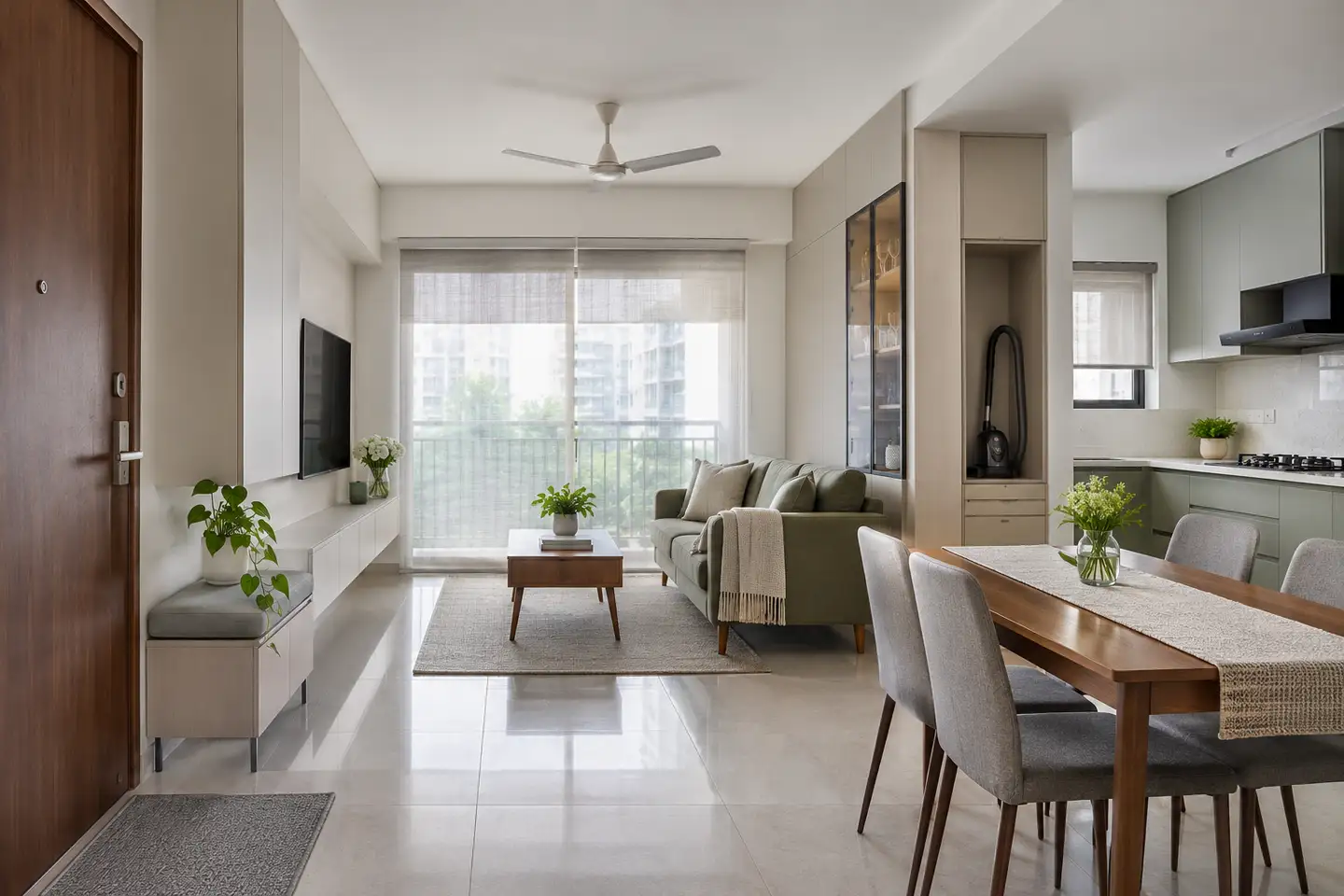
Featured image: illustrative design concept.
A low-dust home is not an empty white box or a home sealed permanently from outdoors. It is designed to reduce places where dust collects, make cleaning easier and respond sensibly to changing outside air. In Indian cities, that means considering construction dust, road particles, cooking emissions, incense, textiles, pets and the dust ordinary sweeping can lift back into the room.
Recent Indian research reinforces the need to consider indoor and outdoor sources. A June 2026 Agra study found that cooking dominated indoor contributions at one residential site, while outdoor dust infiltration was prominent at another setting. An IIT Gandhinagar apartment study published in 2024 also observed particles travelling across rooms. Dust control therefore begins with layout and source management—not only a purifier purchased after handover.
Start at the threshold
The entrance is the first opportunity to stop outdoor dust travelling through the house. Provide a durable washable mat long enough for more than one step, and ensure it lies flat. A nearby bench makes changing footwear easier, while closed or ventilated shoe storage keeps the passage organised.
Avoid elaborate floor grooves or porous details in this high-traffic zone if they cannot be cleaned easily. The floor beneath the shoe cabinet should remain accessible through raised legs, a wall-hung unit or a removable plinth.
Replace accidental ledges with intentional display
Every projection can become a dust shelf: stepped false ceilings, deep mouldings, open loft tops, slatted walls, decorative grooves and the narrow space above a wardrobe. These features are not automatically wrong, but each adds maintenance. Use them where they contribute meaningfully instead of repeating them across every room.
Take tall units cleanly to the ceiling or leave a genuinely accessible gap. Avoid a narrow strip that is visible but impossible to reach. Closed cabinets reduce exposed surface area; a glass-front cabinet can display selected objects while limiting routine dusting. Reserve open shelves for items used or cleaned frequently.
This complements the guide to planning storage before cabinets: decide what must be displayed, concealed or accessed daily before drawing the unit.
Design clear cleaning routes
A room may look minimal yet remain difficult to clean if furniture sits too low for a vacuum, too close to the wall for a mop or inside a maze of fragile décor. Choose furniture with enough clearance beneath it, or a properly closed base that does not collect dust underneath.
Keep circulation wide enough to clean without shifting several heavy pieces. Wall-hung media units and vanities can open the floor when mounting and service needs are resolved correctly. At fixed cabinetry, avoid unnecessary recesses at corners and skirting transitions.
Robot vacuums may influence plinth heights and furniture clearance, but the home should not depend on one appliance model. Confirm dimensions and docking requirements before production while retaining access for conventional cleaning.
Choose surfaces for the way you clean
The Ministry of Health and Family Welfare’s 2025 air-pollution advisory recommends damp sweeping or wiping instead of methods that resuspend dust. Interior finishes should tolerate routine wiping without swelling, staining or losing their surface.
Smooth does not have to mean glossy. Matte laminates, sealed stone, finished wood surfaces and washable paint can be practical when specified for the correct location. Deep textures may hide marks visually but hold dust physically. Before approving a highly ribbed panel or rough wall finish, ask who will clean it and with what tool.
Textiles deserve the same review. Removable cushion covers, washable curtains and rugs that can be lifted are easier to manage than permanently fixed fabric panels. Tightly woven upholstery generally releases surface dust more readily than very deep textures, subject to care instructions.
Material decisions should also consider emissions and moisture resistance, as explained in healthier interior materials and moisture-smart interiors.
Contain cooking particles near the source
Cooking is not only a kitchen-cleaning issue. The IIT Gandhinagar study found that cooking-related particles could move through a multiroom apartment. A chimney or exhaust system should be sized and installed professionally, vented correctly where permitted, and kept accessible for filter and duct maintenance.
In an open kitchen, avoid placing the hob directly beside soft furnishings when another safe arrangement is possible. A partial glass partition or closable door may help some households contain odour and particles. The answer depends on cooking habits, gas or electrical requirements, ventilation and the apartment plan.
Make ventilation responsive
Opening windows can help when outdoor conditions are favourable, but can admit traffic or construction dust when air quality is poor. The 2025 government advisory recommends ventilating where possible and restricting outside air during poor conditions. A well-designed home should support both modes.
Use operable windows with maintainable seals and simple treatments that do not obstruct opening. Provide accessible exhaust systems for kitchens and wet areas. If air-conditioning or filtration is used, keep filters reachable and follow maintenance instructions. An air cleaner may supplement source control; it does not replace cleaning or extraction. The advisory also cautions against devices that generate ozone or harmful by-products.
Plan the final clean before move-in
Interior execution produces sawdust, drilling dust and packaging debris that can remain in cabinet corners, service voids and air-conditioner filters. Specify a staged clean before handover: remove loose debris, vacuum concealed spaces, wipe reachable surfaces, and inspect drawers, lofts and ventilation grilles.
Photograph service access and record filter types and cleaning instructions. Do not install soft furnishings until major cutting, sanding and touch-up work is complete. A polished photograph is not proof that hidden cavities are clean.
Questions before approving the design
Which shelves and ledges require weekly dusting?
Can the floor beneath every major piece be reached or fully sealed?
Are curtains, rugs and upholstery components removable?
Can kitchen, exhaust and air-conditioning filters be accessed?
Does the home support closed-window and natural-ventilation modes?
Is post-construction cleaning documented?
When comparing interior design firms in bangalore, ask to see maintenance considered on the furniture plan, ceiling details and material schedule—not added afterward. The best low-dust interior does not eliminate personality. It edits inaccessible detail, contains major sources and makes ordinary cleaning simple enough to remain consistent.
Sources
“Integrated Indoor-Outdoor Characterization of PM2.5: Chemical speciation, water-soluble components, gas–particle interactions and aerosol thermodynamics in urban and suburban environments”, Atmospheric Pollution Research, June 2026.
Thakur and Patel, “Characterization of particulate matter in a multizonal residential apartment: transport, exposure, and mitigation”, 5 August 2024.
Ministry of Health and Family Welfare, “Health Advisory on Air Pollution, 2025 under NPCCHH”, 1 November 2025.